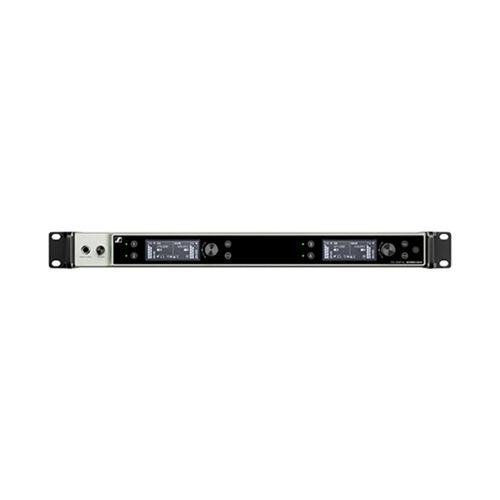
The EW-DX is Sennheiser's digital wideband system, and the thing that makes it worth asking for by name is less glamorous than the spec sheet suggests. It is not the audio. It is that four channels live in a single rack unit, and that a receiver will sit down next to seven more and coordinate with them rather than needing its own frequency plan drawn up by hand.
Four channels to a rack unit
Each EW-DX EM 4 is a four-channel digital UHF receiver in a full-width 1U chassis. Four channels to the rack unit is the number that decides what you can physically get into a flight case and onto a truck: a thirty-two channel system is eight rack units of receivers, not sixteen. The chassis draws 37 W and weighs 5.2 kg, so even a full rack stays a one-person lift.
Both output paths are live at once: Dante for anyone running audio over the network, and analogue XLR for everyone else. That matters more on a hire than on an install, because you rarely get to choose the desk you are plugging into. The same receivers go to a Dante-native mix position one week and a straight analogue split the next without touching anything but the patch.
The S1-10 range, and the licence that goes with it
Our EW-DX stock is S1-10, covering 606.2–693.8 MHz. In the UK that spans both the shared channel 38 allocation and the licensed band above it, which in practice means most venues are workable - but on anything with a real channel count you will want a coordinated licence rather than relying on the shared space. We hire Ofcom PMSE licences alongside the kit for exactly that reason.
Prebuilt, or built to your layout
There are two ways to take EW-DX out of here, and neither is the “proper” one.
Prebuilt racks. We keep EW-DX made up as 8-way, 16-way and 32-way systems, each racked, wired, antenna-distributed and coordinated before it leaves, with the transmitters already paired and a printed sheet of what is on which channel. If your channel count matches one of those, it is the quickest route and there is nothing to assemble at the other end.
Your own layout. If it does not match - or the rack needs to share a case with your comms, your IEMs or a switch - you can lay one out yourself in our rack designer, drop the receivers in where you want them, and we will prep it built to that drawing rather than sending you a box of loose units to assemble on a loading dock.
Either way the difficult hour happens here rather than there. Frequency coordination across a 32-channel system is not hard, but it is fiddly, and doing it once in the workshop on a rack that then ships as a unit is the single biggest practical difference between hiring a system and hiring eight receivers.
It does not have to be the whole system
EW-DX sits alongside the rest of our radio mic stock rather than replacing it. Plenty of jobs are better served by a smaller analogue system, and we still rack and hire those too - a four-way for a panel session does not need wideband digital and a Dante patch. Where EW-DX earns its place is channel count, rack space and coordination: the moment you are past about twelve channels, or fighting for rack units, the maths changes.
What to tell us when you enquire
- How many channels, and the split between handheld and bodypack. The receivers are identical either way; the transmitters are not, and the split decides what we pack.
- Where it is going. Venue and postcode, so we can check what else is licensed nearby and coordinate around it rather than discovering it on site.
- Dante or analogue. Both work, but it changes what cable we send.
- Whether it shares a case. If the radio mics travel with comms, IEMs or a network switch, say so and we will lay the rack out around all of it.
- How long. Past a week the rate ladder is worth a look - a fortnight does not cost twice a week.
If you already know the channel count, the fastest route is to pick the rack size that matches it and check your dates. If you are not sure yet, tell us about the show and we will work it out with you.